
What Is the Best Season for Surfing in the Hamptons?
Of course, this is a hard question to answer objectively, as it depends on your individual viewpoint on what makes for "good surfing." What is your preferred size range? Would you rather surf rippable waves, or get barreled? Would you rather surf lots of fun days, or a few epic ones? And on that matter — what is "fun" to you? What is "epic" to you? Does water temperature and weather play a factor?
To answer this question to the best of our abilities, we went through Surfline's historical forecast for Atlantic Terrace, and rated every day (using our imperfect and subjective rubric) dating back to January of 2015. Then, we arrived at a total score for each month, and averaged those totals for each respective month over an 11-year span (January 2015 through December 2025).
The Scoring System
We scored individual days on a scale from 0–4, based on the assumed perspective of a surfer who is at a high enough level to get barreled, do turns, and is not intimidated by a big day for eastern Long Island standards (up to 12–15 foot faces).
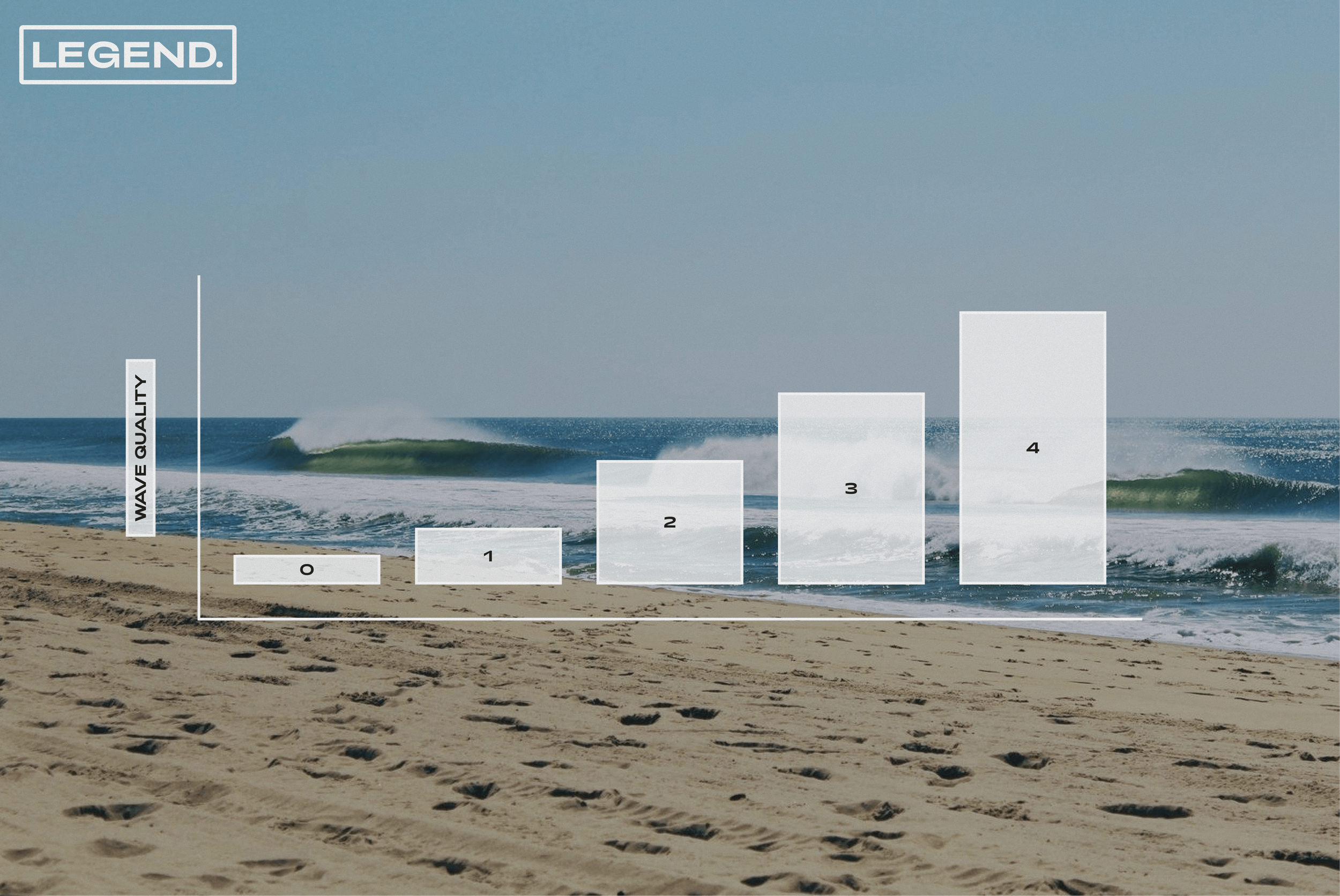
0 — If there is no real option to ride a relatively clean wave that is at least chest high, that day receives no score. Generally, any day that had a deep water swell height of less than 4 feet, or a period of less than 7 seconds (regardless of direction) scored a zero. Likewise, if the swell was solid, but there would have been no place that you could surf that was not blown out, then the day did not receive a score.
1 — You can find somewhere to surf where you can maybe get a fun little tube, or do some turns. The right inside sandbank might be fun, or one of the points in Montauk might be rippable. Nothing overhead, but still, a day worth surfing if you have the time. Certain bigger days that did not have offshore winds, but still had manageable enough wind to do some bigger face turns, or maybe even find a sneaky barrel, usually scored a 1.
2 — The surf is high quality, and head high++. If the sandbanks are set up well, and it is the right swell direction for them to turn on, you can get barreled. If it is the right direction for any of the points in Montauk, you can link together some turns and maybe even find a barrel section. The outer bars might have some almond barrels around the right tides. To score a 2, the wind would have to be offshore, unless it was a particularly good size and direction for the points in Montauk — and even then, it had to at least have been fairly glassy (side/onshore winds less than 7–8 mph).
3 — It's absolutely firing. It's too big for the inside sandbanks for the most part, but depending on the swell direction and period, either the outer bars or points in Montauk, or both, are as good as they get. The waves are well overhead — double overhead++ — and offshore wind is non-negotiable.
4 — A historically good day. It is beyond just firing; it is a day that will go down in local surfing lore for years to come. We gave out four 4's between 2015 and 2026.
Note: For a score to be given, the day in consideration must have met the criteria for that score for at least 90 minutes during daylight hours. The duration of optimal conditions does not impact a day's score, unless those conditions were met for less than 90 minutes.
The Results
To get these results, we added up the daily scores for each month from 2015–2025, and then divided each month's total score by 11, to find the average monthly total score for each month over that 11-year period. Below is each month's average, ranked from 1–12, along with the median score.
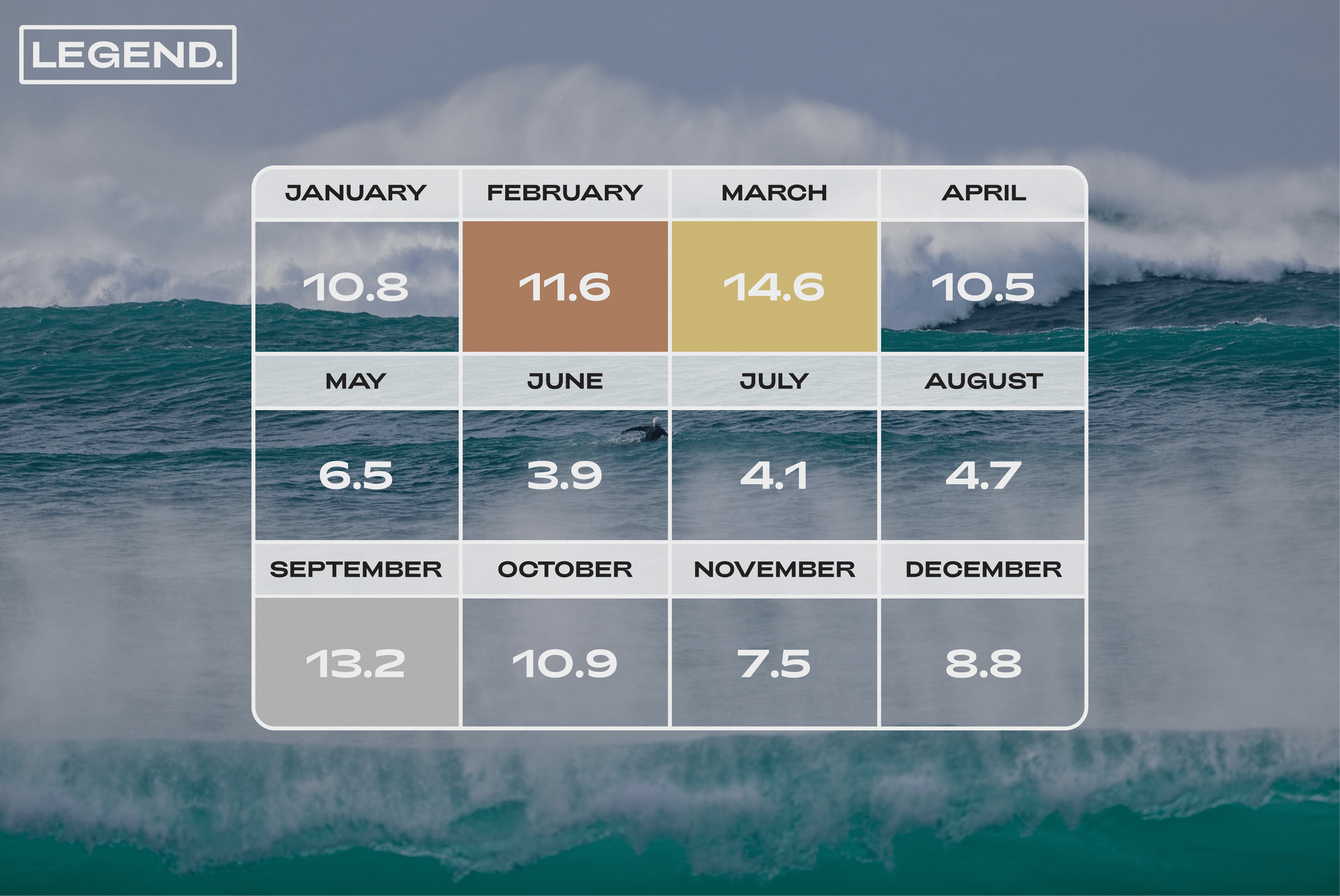
| # | Month | Average | Median |
|---|---|---|---|
| 1 | March | 14.6 | 15 |
| 2 | September | 13.2 | 11 |
| 3 | February | 11.6 | 10 |
| 4 | October | 10.9 | 11 |
| 5 | January | 10.8 | 12 |
| 6 | April | 10.5 | 10 |
| 7 | December | 8.8 | 8 |
| 8 | November | 7.5 | 7 |
| 9 | May | 6.5 | 6 |
| 10 | August | 4.7 | 4 |
| 11 | July | 4.1 | 5 |
| 12 | June | 3.9 | 4 |
Our Interpretation of These Results
In the grand scheme of things, an 11-year sample size is very small, so these results are not perfect. But there are some telling patterns here, which can serve as a starting point when considering which months are the best for surfing on Long Island's east end.
❄️ The Winter Months — Consistency Is King
Each hemisphere has its most active mid-latitude storm track during its respective winter. Being in the northern hemisphere, Long Island (and the entire U.S. East Coast for that matter) is going to be situated closer to stronger and more frequent mid-latitude storms during the winter months than during the summer. Now, that does not always mean good waves — but it directly correlates to higher odds of receiving solid swell from mid-latitude born storms, and more consistently so.
🌀 Late August / September — Feast or Famine, With More Stable Weather Conditions
The North Atlantic hurricane season reaches its statistical peak in mid-September, with a steep bell curve leading up to it through the end of August, and falling away in October. Almost all of the big scores in August or September are going to come from hurricanes, which are so special for the East Coast, because they are the only type of storms that somewhat reliably track towards the coastline (as opposed to mid-latitude storms, which usually track west to east with the jet stream). This can create longer-lived, and longer-period swells.
Since 2015, August has been feast or famine, with more famine than feast. Still though, a few decent Augusts boosted it slightly above its summertime counterparts of June and July. September has been a different story — many Septembers in recent memory delivered for eastern Long Island, fueled by active and favorable hurricane tracks. Even so, if it weren't for a few high outliers (2017 and 2023 in particular), September would rank below most of the winter months in the observed time period. That is because hurricanes are fickle, and without them, September starts to look a lot more like August than February, from a surf standpoint.
🍂 Shoulder Season Productivity — A Product of More Stable Weather Than Winter's Depths?
Despite November–February being the climatological peak of the northern hemisphere's winter, October, March, and April have performed even better as a whole than the deep winter months, over the last decade at least. This could be due to the shoulder seasons (fall/spring) still benefitting from a winter-like mid-latitude storm track, while enjoying slightly more stable local weather conditions. There were more days of solid swell in the winter that were destroyed by the local wind, than there were in the spring and fall.
The winter in the mid-latitudes might be a case of "too much of a good thing", when it comes to storms, and their impact on local surf conditions. Another factor: longer daylight hours. The short daytime hours during the winter means greater chances that the window of good waves you're waiting for might not happen until after dark.
☀️ Summertime Sadness
The summer is by all measures the slowest season for surf in eastern Long Island. Too late for winter storms, and (usually) too early for hurricanes. Of course, the warm water and long days make the swells that do occur more inviting. And there are plenty of fun days for the longboard or the groveler that do not quite reach our criteria to score points. It's a great time for beginner or intermediate surfers. But if you're looking to get barreled (or really lay it on rail), summer is not likely to provide what you're looking for with any level of consistency.
